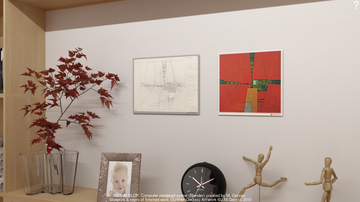
Gunther Gerzso’s Blueprints (Design Drawings): His Record As Art of His Life’s Work.
March 1, 2024
Gunther Gerzso’s original ambition was to be a set designer in the theater. He ended up working on sets in the Mexican movie business for about 20 years until it collapsed during the 1950’s. After that, he was at a loss as to what to do even though he had always been painting on the side. He did not like the idea of becoming a full time artist, but he needed to make a living and the encouragement of his friends and family changed his mind. And yet, he could not give up drafting and designing as he had done in the movies. By 1966, he had developed a technique based on blueprints which he used for almost every work of art he produced. He combined his knowledge of the practice of design with his knowledge of painting. That is, art by design.
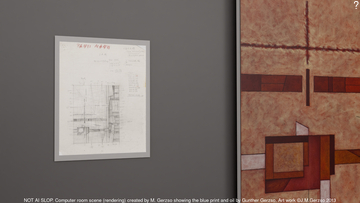
The common use of the term “blueprint” refers to a design drawn to scale ("a plan or design that explains how something might be achieved", Cambridge Dictionary). It is equivalent to a blueprint but not blue. In Gerzso's case, it may include color, shading or annotations, and it contains enough detail to make an object it represents or to develop construction drawings as used in architecture and engineering. It is the result of a creative process which is also known as “drawing to find out” (reference to Louis Kahn) and which occurs while making the drawing itself. The design process usually produces several variations which illustrate several patterns and possibilities.
All architectural, engineering, industrial, graphical, set etc. etc. designers frequently produce blueprints in one form or another. Their importance in the design process has been the subject of many lectures and voluminous writing by academics and professionals.
On the other hand, in my experience, non designers tend to conclude that sketches, blueprints and final drawings (portraits, perspectives etc.) are the same type of work. Discussing why they are different could be the subject of another note or essay.
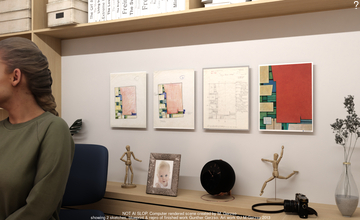
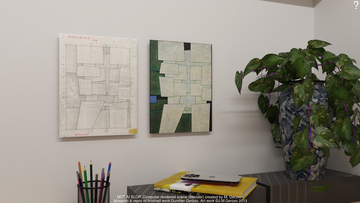
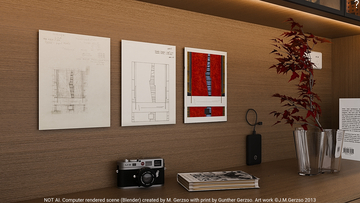
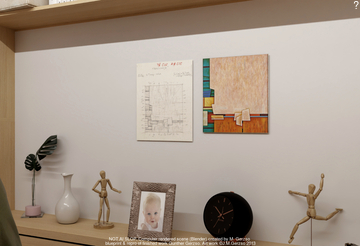
In contrast to architectural practice, Gerzso never needed to produce final construction drawings because he executed the design himself. He was certainly capable of painting from a sketch, but he rarely did so. After beginning a work, he would not modify the geometry, basic colors or the texture. For prints and sculptures, he would work closely with the shop craftsmen. As a consequence, all completed works are accurately represented by a drawing. That is, for each work there one and only one drawing to scale. If on the other hand, he was not satisfied with a painting for example, we would destroy it and literally go back to the drawing board which was near his easel.
Gerzso drew on letter sized sheets of paper. Surrounding the drawing, he would write annotations of three types. The first one is a description: title, year, number, sometimes the client, etc. The second one is a specification: media, dimensions in centimeters, the scale drawn, and techniques to be used. The last type is a log: dates the painting was started and finished (sometimes it was never started or finished), if it was destroyed, and the techniques used. Logs were not included for prints and sculptures. Additional letter sized sheets were attached if needed.